
Nico restores cars
Tomas Padilla ’28
Ever since Nico Palermo ’28 was a child, he’s had a strong passion for cars. Whether it was helping his dad with repairs or watching him race, Nico has always been intrigued by automobiles. Nico’s first restoration project involved his father’s 1970 Datsun 1600 Roadster.
“I officially started working on cars around the age of 10,” Nico said. “I mainly attribute all my knowledge to and passion for cars to my father. Most of what I know has come from learning alongside him, understanding how things work”. Working on cars has also taught Nico key life skills such as “patience” and “attention to detail,” he said.
Nico’s current and biggest project is a full frame-off restoration of his 1974 Triumph Spitfire. Nico received the car about a year ago from one of his dad’s friends who had found the car in a barn. His goal was to “complete the restoration in time” to have a car for his 16th birthday. Unfortunately, Nico has missed the deadline due to delays on shipments.
“The simplicity of old cars,” said Nico, “is something that can never be recreated.”
Throughout the project, Nico has used many familiar tools, but on this Triumph Spitfire there have been specific new tools that he’s needed to learn how to use.
“The Dual Su HS4 carbs needed a specific tool to set the air fuel mixture so that it is not running high on idle or too low,” he said. “Another specialty part was the clutch alignment tool which allows us to align the clutch behind the pressure plate so that we could mate the transmission to the motor.”
To get the engine running, Nico had to learn how to measure and set valve lash, gap and file the piston rings, setting the distributor and timing.
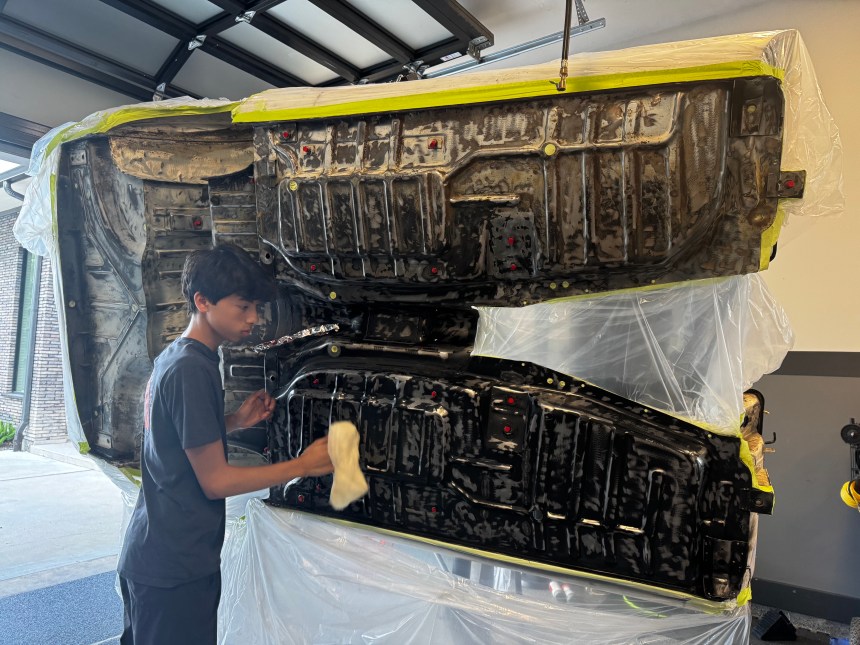
“One of the hardest parts of the entire project,” Nico said, “was creating our own rotisserie to change out the corroded floor pans that had collected water from sitting in the barn where it was found.”
An automotive rotisserie is a heavy-duty steel tool used to hold a car body or frame securely during the restoration process, allowing the vehicle to be rotated 360 degrees. The measurements for the floor pans had to be precise or none of the floor bolts would line up to bolt to the chassis.
The next challenging part of the project for Nico was learning how to weld, the process of melting and joining metal parts together, using a torch to blend the materials into a single, solid piece.
“Welding is something that I had never learned to do,” Nico said. “It was especially tricky because we were welding thin sheet metal and it needed to be exact. Too hot and it would make a hole in the floor and we would go back to square one. Too cold and the material would not take the welds and it would not mate.”
Nico says that he wouldn’t have been able to complete this task without his dad, who helps Nico enjoy his work.
“I also enjoy this work,” Nico said, “because I know that when it is finished, it will be fulfilling and something that I can trust because I built it with my own two hands.”

